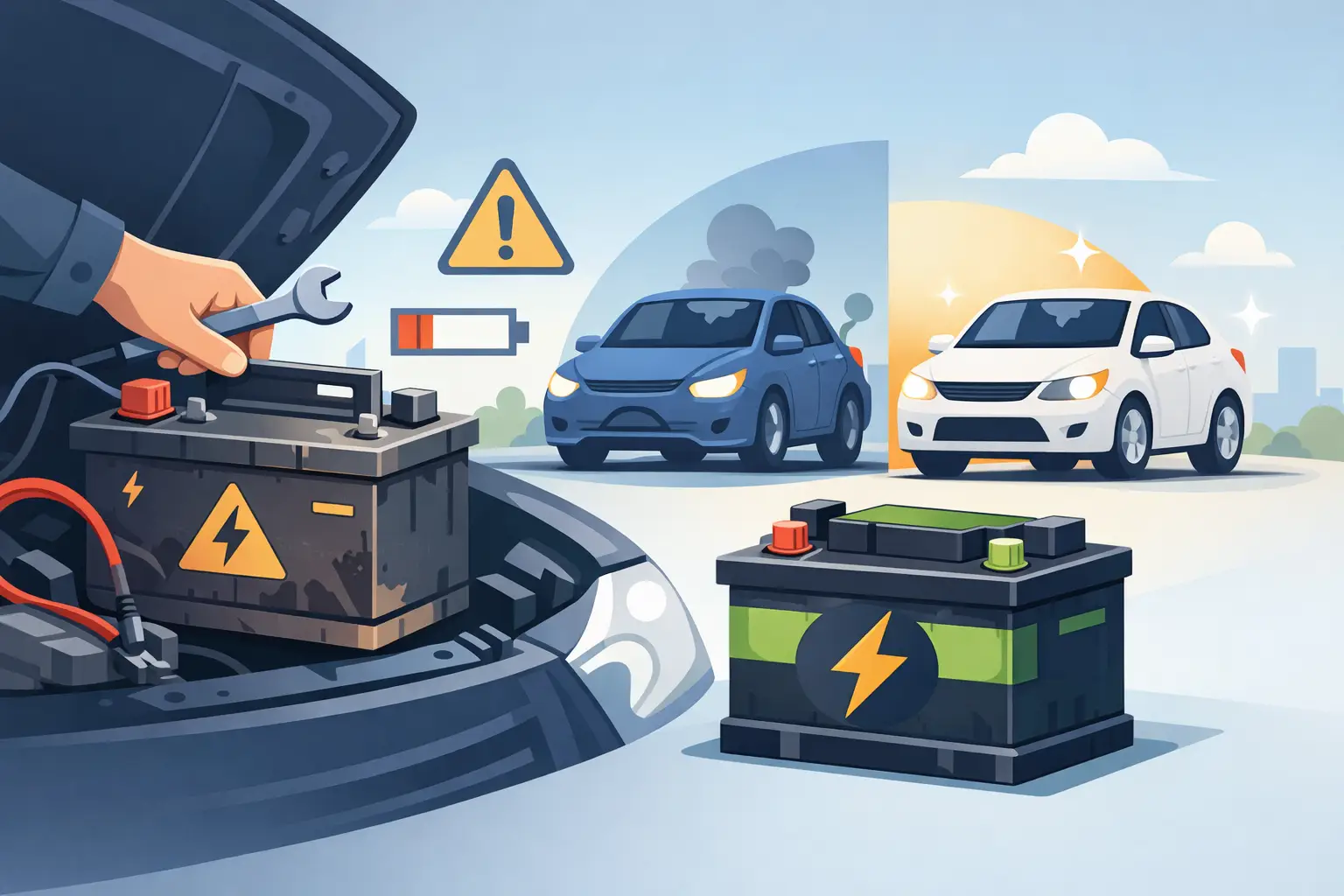
Battery Replacement: Signs Your Car Can’t Wait
A car battery rarely fails at a convenient time. It is usually the morning you are heading to work, loading the family car, or preparing a work vehicle for a busy day. Battery replacement is one of the simplest ways to avoid an unexpected no-start, but only when the real condition of the battery and charging system is checked properly.
A slow crank, dim lights, or a warning light may point to a tired battery, but they can also indicate loose connections, corrosion, an alternator fault, or a parasitic electrical drain. The practical approach is not to guess. Test the battery, inspect the terminals, and make sure the vehicle is charging as it should before fitting a replacement.
When Is Battery Replacement Needed?
Most vehicle batteries last around three to five years, although that range can be shorter for cars that spend long periods parked, make frequent short trips, or operate in very hot conditions. Age matters, but performance matters more. A battery can look fine from the outside and still no longer hold enough charge to start the engine reliably.
The clearest sign is a slow or labored engine crank. If the starter motor turns the engine over more slowly than usual, particularly first thing in the morning, the battery may be losing capacity. Do not wait for it to fail completely. A weak battery can leave you stranded with little warning.
Other signs worth acting on include:
- Headlights that appear dimmer at idle or interior lights that fade when starting the car.
- A battery or charging-system warning light on the dashboard.
- Electrical accessories such as power windows, central locking, or the radio behaving inconsistently.
- A swollen battery case, visible fluid leakage, or white and blue corrosion around the terminals.
- A battery that needs frequent jump-starts despite regular driving.
One symptom alone does not always mean the battery is finished. For example, a battery warning light often relates to the alternator or drive belt rather than the battery itself. That is why a proper inspection is worth more than replacing parts based on a dashboard light alone.
Why a Battery Test Comes Before Replacement
A voltage reading is useful, but it does not tell the whole story. A fully charged but worn-out battery may show normal voltage while parked, then collapse under the heavy load required to start the engine. A workshop battery test measures its ability to deliver current, compares that result with its rated capacity, and checks whether the alternator is restoring charge after the engine starts.
This saves money and avoids repeat problems. If a new battery is fitted to a vehicle with a charging fault, the new unit may soon go flat as well. If the issue is a poor terminal connection, replacing a good battery will not fix it. A technician should inspect the battery terminals, earth connections, wiring, alternator output, and belt condition where applicable.
For newer vehicles, testing also helps identify battery-management issues. Many late-model cars have stop-start systems, high electrical demand, and sensors that monitor battery condition. These vehicles may require a specific battery type and, in some cases, a battery reset or registration procedure after installation. Fitting the wrong unit can affect stop-start operation and may shorten battery life.
Choosing the Right Battery for Your Vehicle
Car batteries are not one-size-fits-all. The correct fit depends on physical size, terminal layout, cold-cranking amps, reserve capacity, and the electrical requirements of the vehicle. The cheapest option is not always the best value if it has insufficient starting power or does not suit the way the vehicle is used.
Cold-cranking amps, often shown as CCA, describe how much starting power a battery can provide in cold conditions. A family sedan, diesel ute, 4WD, light truck, and work van can all have very different requirements. Diesel engines typically need more cranking power, while vehicles with winches, extra lighting, fridges, inverters, or aftermarket audio systems may need greater reserve capacity.
The battery technology matters too. Standard flooded lead-acid batteries remain suitable for many conventional vehicles. Enhanced flooded batteries, known as EFB batteries, and absorbed glass mat batteries, known as AGM batteries, are commonly used in stop-start vehicles and vehicles with higher electrical loads. An AGM battery generally handles repeated charge and discharge cycles better, but it costs more. Replacing an AGM battery with a basic conventional battery can be a false economy.
A correct replacement should match the manufacturer’s required specifications or be an approved equivalent. It must also fit securely in the battery tray. A loose battery can be damaged by vibration, create electrical connection issues, and become a safety concern in an accident.
Short Trips Can Be Hard on a Car Battery
Many drivers assume regular use automatically keeps a battery healthy. That is not always the case. Starting an engine uses a significant amount of stored energy, and short trips may not give the alternator enough time to fully recharge it. If the car is used mainly for school runs, local errands, or brief commutes, the battery can remain in a partially charged state.
This is especially common when accessories are used heavily. Demisters, headlights, air conditioning blowers, heated seats, phone charging, dash cameras, and infotainment systems all place demand on the electrical system. A healthy charging system can manage these loads, but an older battery has less capacity in reserve.
Vehicles left unused for weeks can have the opposite problem. Small background draws from alarms, keyless entry systems, clocks, and onboard modules gradually discharge the battery. If a vehicle is stored or only driven occasionally, a quality maintenance charger may help, provided it is used correctly. For a vehicle that repeatedly goes flat, however, the cause should be diagnosed rather than covered up with a charger.
Corrosion, Loose Terminals, and Simple Problems
Battery terminals need a clean, tight connection. Corrosion can increase electrical resistance and make a good battery act weak. You may notice powdery white, green, or blue buildup around the terminals, difficulty starting, or intermittent electrical faults.
Cleaning terminals can help, but it should be done carefully. Batteries contain corrosive material and can produce flammable gases. If there is heavy corrosion, a damaged terminal, a cracked case, or fluid leakage, have it inspected by a qualified technician. The battery hold-down should also be secure, as movement can damage cables and internal battery plates over time.
A visual check is useful, but it cannot confirm internal battery condition. Think of clean terminals as basic maintenance, not proof that the battery has plenty of life left.
Battery Replacement for Work Vehicles and 4WDs
For tradies, delivery vehicles, 4WD owners, and trailer operators, a battery issue can mean lost time and missed work. These vehicles often have added electrical loads, from tool charging and auxiliary lighting to refrigeration, communications equipment, or towing accessories. The starting battery needs to be selected with the vehicle’s real-world use in mind.
A dual-battery setup can be a smart option for some 4WDs and touring vehicles, but it is not necessary for every driver. It adds cost and requires proper wiring, battery isolation, and charging management. If the main issue is an aging starter battery, replacing it with the correct quality unit may be all that is needed.
For fleet and work vehicles, it pays to test batteries before they become emergencies. A quick check during routine servicing can identify declining capacity early and help schedule replacement around work commitments instead of reacting to a breakdown.
Get the Job Done Properly
A battery is a small part with a big job. It starts the engine, supports essential electronics, and helps keep modern vehicle systems operating as intended. Choosing the right battery, fitting it securely, and confirming the charging system is healthy gives you far more confidence than simply installing the first battery that fits.
At Ryan Automotive and Tyres, drivers can have the battery, terminals, and charging system checked as part of practical one-stop vehicle care. Whether you drive a commuter car, family SUV, ute, truck, or 4WD, the right test can prevent downtime and help you choose a battery that suits the vehicle and the work it needs to do.
If starting has become slower, the battery is more than a few years old, or your vehicle has needed a jump-start, arrange a check before the next no-start turns a normal day into a tow-truck problem.